We are infinitely loved
Yesterday my year 12s were blessed to have Fr William talk to them about the Sacred and how the Chapel is a Sacred Space. Whilst there are many aspects to reflect on when considering a concept as huge as Sacred there is one I wish to reflect on today. When we enter Chapel we do so making a gesture of humility as we enter into a space to be present with our God. Absolutely we should be humble before God who is omniscient, omnipotent, omnipresent and we are but creatures of dust. We aspire and fail, aspire and fail, and then aspire some more. But I think the blessing of our humility is that flawed as we are, we are infinitely loved by God. Therein (for me) lies the crux of humility – that one so limited is loved by one so infinite. That this love exists as no result for any endeavour I have undertaken and will not dissipate through my flaws. It is something beyond the comprehension of words I think, but in this sense of the Sacred we are invited into relationship with God. This is why a true love of self is not arrogant, true love of self brings humility. I turn to St Paul in his letter to the Corinthians:
Love is patient, love is kind. It is not jealous, is not pompous,
it is not inflated, it is not rude, it does not seek its own
interests, it is not quick-tempered, it does not brood
over injury, it does not rejoice over wrongdoing but
rejoices with the truth.
It bears all things, believes all things, hopes all things,
endures all things.
Love never fails.
To some extent humanity has taken the idea of love and (like many things) secularised it. The truth is we cannot love ourselves as God does, because we are not God. But we can find the space to remember and be grateful for that love – whether that be in a defined sacred space, out in the world God created or in a quiet moment of reflection inwards where distraction fades.
I think that as we approach Lent it is a good time to think about how we can ‘step-into’ that love that exists all the time – even if we don’t always think about it.
The difference between word and deed
Recently I heard in a homily – the evil in the world exists because of the discrepancy between our words and our deeds. It struck such a chord that I took my phone out and typed it in so I would not forget. Further comment that adds to the context was that we are not a people of amnesia. That we have not forgotten everything. It really is a choice.
Consistency. This word is mentioned in so many arenas and I think it warrants a mention in our personal approach sphere. How many times have you heard someone say something about another that is the exact opposite to your experience of that person? I have several times and logically I know therefore that this must also be the case for myself. We are not consistent in how we treat others. But, if our values and beliefs direct our actions why is this so? Should we not treat all equally? We don’t. So what directs our actions if not our values and beliefs?
Is it possible our values and beliefs no longer influence us as we expect? If so – what then holds this power of influence? I think of the letter of the law part of the Gospels where Jesus challenges the pharisees and suggests to enter heaven we need to do more than the letter of the law is important. Too many times today we tick boxes and call ourselves just and full of integrity. Integrity comes from within not from how we are perceived. So if we know that our love and compassion has to come from our hearts and within why do we not afford this lens to all our interactions?
A bit ‘judgy’ aren’t we? A bit reactionary. A bit emotional. Perhaps it is our emotions that have surpassed our values and beliefs in directing our actions, which is why we are not acting as we know is right ‘consistently’.
We have limited control over our emotions so why allow them to control our actions and our words?
Don’t sweat the small stuff … or is the devil in the details?
In South Australia we currently are experiencing a spike in Covid-19 cases and as it made me think of the difference between the need to think ‘big picture’ but then also the impact this has on individuals. It seems to be a Catch-22 where we need to have decision-makers who think of the big picture and don’t lose sight of forward planning by the emotional connection and plight of the immediate, but it is in the every-day that we truly make a difference. As a (I’d like to say mathematician but I don’t feel qualified – my degree was too long ago and it is not an active component of my daily life) logical thinker who has been blessed with an education around mathematical thought and processes, I know that we need to engage in modelling and optimisation and there are mathematical and logical processes and calculations that help project outcomes in a potentially viable model – even to the point of considering anomalies etc and adjusting equations to consider this; but from working with people and sharing their journeys I know that it is the emotional connections, not the abstract, that keep those ‘on the ground’ hopeful for the future and willing to adopt measures that ‘big-picture thinkers’ assure us will project the most positive outcome for the majority. So for the big-picture process to work we need individuals to feel connected to the process, but we need to look beyond the immediate if we are to navigate our way forward. A tricky cycle.
As is often the case Jesus is the example to follow. Who else in history has seen the big picture, known it, been a big part of it and yet has taken the time on a daily basis to engage with the everyday and connect with those who stand to be marginalized by some who suggest they have the big-picture? The thing I keep coming back to is that Jesus was the great includer. Yes I know that is not a real word but it has been a phrase that arose in my brain decades ago, from where I don’t recall, and it remains the phrase I associate him with the most. The Great Includer.
One of the challenges inherent in big-pictures is that many of us don’t feel included or that our voices are heard. This leads to a question of – am I valued – do I matter? Inclusion is potentially the greatest step forward humanity can make in actualizing human dignity. We all have it apparently – not all feel this is true and let’s be honest – not all act like it is true. If I am a part of something bigger then I can do the wrong thing and be told that without it rocking my fragile sense of self-worth. What would this do for our collective mental health? How can we paint ourselves (or others) into this big picture?
This is the challenge I want to see taken up in 2022 – how can we be more collectively and individually inclusive? Who can you include that currently you do not? Who can authority include that currently has no or little voice? How can we all open our ears, and then open our arms, our hearts and our mouths to invite them in whilst working together to build a safe and prosperous tomorrow? It is very likely that someone who has felt excluded will run from the first offer of inclusion but then surely it lies with the inner sanctum to offer again and again, finding new methods, because as a global humanity we need to make sure that our big picture does not erase any of our image.
Hello 2022!
A new beginning.
Our lives are full of new beginnings. When things change in our professional, familial, social world we embark on new ‘chapters’ and yet we are guaranteed of this one new beginning every 365 days. Perhaps it is this consistency that allows us to take it somewhat for granted. We develop our annual rites of passage to mark the transition from one year into the next. It really is a time to reflect on the year that was and set goals or intentions for the year that is about to begin.
I felt drawn to the Book of Joshua – that transition from Moses to Joshua and from wandering in the desert into the Promised Land.
‘Be strong and stand firm, for you are the man to give this people possession of the land that I swore to their fathers I should give to them. Only be strong and stand firm and be careful to keep all the Law which my servant Moses laid on you. Never swerve from this to right or left, and then you will be happy in all you do. Have the book of this Law always on your lips; meditate on it day and night, so that you may carefully keep everything that is written in it. Then you will prosper in your dealings, then you will have success.
Have I not told you: Be strong and stand firm? Be fearless then, be confident, for go where you will, the Lord your God is with you.’
Firstly, when thinking about the Jewish covenant with God, I transfer this concept to my Christian world view. I don’t tend to frame it in the context of a covenant or an agreement, but socio-culturally my context is vastly different to the time when this was the semantics. I enter into a relationship with God. It essentially is just like (I think) the OT Covenant. The word ‘relationship’ is bandied about today a lot. In education it is all about building relationships with students so they feel safe and can learn. In life we build relationships with people we find some affinity with as we seek connection. How is my relationship with God different to all this?
In daily life if the other person does not put effort or put ‘in’ to the relationship ultimately we will walk away, we reach that point when it just seems hollow and one-sided, or it will just fade into insignificance and die a natural death. I cannot speak to how God puts ‘in’ to our relationship, nor can I explain how I feel like God is there, all I can do is think about how do I put into our relationship?
Communication is always important in relationships. I pray. I make time for God. I think about God (possibly not as much as I should). Mostly though, when I think about what I put in – I bring this understanding that this relationship is grounded eternally in a love that cannot ever fade away to nothing, that it is a part of who I am and even if the ground disappears beneath my feet the foundation of this relationship will always exist. I would have to not exist for this relationship to not exist. That may make no sense to some but it is what it is, just as I am who I am. This sense I have experienced with other people to a lesser degree. I’m sure many have. We have those friendships or relationships that go untouched for periods of time but then when you communicate again the glimmer of love and connection is as bright as it was when contact was daily, there is something within that will remain with you for life. When I enter into relationship I allow that person to take up some residence in my heart or my soul and this is the centre from which I determine the me I want to be. And isn’t this the time to think about who we want to be this year?
Like Joshua, I have understandings that I need to keep with me and not just store them, allowing this to shape my current responses to things – if we do not use our knowledge it becomes a dusty book on a shelf in a digitized world. Let’s face it – we know a lot of stuff, but we do not allow all of this knowledge to influence our decision making processes, we are called to be selective. So what will I bring with me from 2021 (and the years leading up to this)? What does it mean for me to prosper and have success? I have never really been one to carry purely academic knowledge with me. Even with my mathematics background it has been more my ability to apply reason and seek to prove and to analyze that I carry rather than theorems and concepts. I hope to carry that desire to seek the truth and to prove that it is truth (to myself and sometimes to others). I have always loved literature and the deeper meaning inherent in symbolism. That too I wish to bring into 2022. Over the past decade I have a growing element in my relationship with the world. It is not all about me. Previously, I admit, I have essentially looked on the world through a lens that wanted ‘me’ to be ok. Now I want my human dignity to be upheld and a part of that is I need to uphold the dignity of others. My dignity is inherently bound to the dignity of my global cousins (I use the word cousins as it is gender neutral and just kind of fits). My relationship with the world is not just me and the world – it is ‘us’, an all-encompassing ‘us’. I hear the words in the Book of Joshua: Be strong and stand firm. This is what I hope will shape my 2022.
What will you bring with you?
The last line of the reading humbles me a great deal.
Be fearless then, be confident, for go where you will, the Lord your God is with you.
I will fail. I will venture into situations willingly that do not uphold my dignity. I will act against all that I have written, cause harm, be broken and breaking. My words will at times bring no life only destruction. I know this. I don’t want it and I could say this year it won’t happen but this would be a lie. No matter how I try I will fail. In the words of Brene Brown failure is inevitable – you are going to fail. But ‘go where I will’ my God will not abandon me. This is the hope that buoys my heart and saves my soul. In the darkest moment, if I reach out, God will be there. That is our relationship.
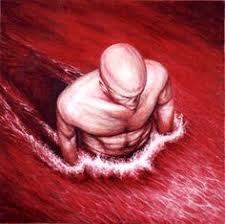
Not everyone has this relationship with God. But everyone needs this sort of relationship. This is where humanity needs to pick up the baton. We need to be that quiet presence in the dark, but to do this we need to be aware of the dark which is not always visible. For don’t we all have that Macbeth moment at some point when we are ‘in blood stepp’d in so far that returning were as tedious as go o’er?’
Some of us are truly blessed with friends who often avert us from that path. Be grateful for them – they are such a blessing, like sunlight breaking through a canopy of trees and letting the colours shine through.
In 2022 I hope to see a world under construction where dignity is acknowledged for all, darkness is a place from which we can return and each person looks to be a blessing rather than be blessed. Together we can wade our way through Covid (in all its variants), counter the climate crisis, render racism to antiquity and pursue peace with all the passion of a bargain-hunter on Black Friday. Bring it on.
Christmas 2021
Firstly, a blessed Christmas to all. At the end of another globally confining year shaded by uncertainty and the fear of what is unknown may the hope of Christmas fill your hearts.
I’ve been trying to find a clear focus to write about but I keep coming back to children and joy. Let’s face it – every child is an infinite blessing – but this child – Jesus -is celebrated today because of Easter. As such the shadow of the cross appears simultaneously with the glory of the star of hope.
Jesus for me is the most powerful human to ever walk the earth. Just look at the impact he has had! We have Christmas because he was born (well really we have Christmas because he died). He was powerful in his humility. He taught us that humility is more powerful than giving commands. So often we desire and cling to authority but Jesus was the most innately powerful but embraced humility. What an un-Christian mess we are making: we even learn how to gain power today, we take courses on how to lead etc. so clearly we seek it, which is very un-Jesus-like, because we either want power or to be with powerful people. Power corrupts. For some reason tonight I keep thinking of the Scripture where Jesus says to the disciples to let the children come to him. It fits with Christmas as children make the most sense of Christmas. As parents don’t we do so much extra for our children and stand down and let others take the credit? Even when they are teenagers (and adults)! A bit humble really – but the most powerful act. We want them to feel special and to believe in something beyond the grey reality of daily life. Just for a moment to have a tangible view of how they are loved beyond measure. How many presents are from parents and how many from Santa? Don’t we do this as adults let alone as parents? Don’t we look to make children feel joy at this time? All children. Inclusion. We are more giving at this time of year than any other. Christmas is when we are so inclusive that no one is outside our sphere of love. All are welcome to be housed within that fence – no-one is deliberately made to stand outside looking in. This is the ONE time of the year we are like this. We hold onto power by excluding – but Christmas is ALL about humility and inclusion. Why is this once a year?
I feel really clouded and lacking clarity but if I could say anything this Christmas it is:
Humility is more powerful than authority.
Children are everything.
Love powers us to be more than we ever thought we could be.
We are richer when we believe in more than the immediate reality, if that something brings hope and encourages us to treat our fellow humans with love and compassion.
Personally, I think there is much that brings joy and much to bring hope. Let us hold onto hope and love and try and recapture that joy that is so overpowering as a child that we run away from at every opportunity as an adult.
Let there be joy this year. Be blessed. Be humble. Be compassionate. Go with love.
A personal reflection
When reflecting on the decade that was (my 40s) as the day begins on this final day, I find I have been blessed by the presence of many angels (working through a wonderful group of people) throughout these past 10 years. It has been this support that has called me to stand on thresholds and be drawn in new directions, being able to accept my own ambivalence and my contradictions as part of my essence in a space where conformity was the directive. This allowed healing. If we don’t find or allow healing, then we fester, and festering makes us rot from the inside out. In so many ways today we pick at our wounds (which is something we were always told not to do by our wise maternal influences) and even when we don’t there are those who do it for us and pick, pick, pick until it opens wider than before. It is those angels masquerading as humans whose compassionate kindness pours balm on those wounds that I give thanks for today. For when we are wounded, we tend to retreat into safety and shy away from the wildness that takes us into the other, away from what is safe, where we can be warriors. And the world needs warriors.
There are angels in my life that have seen what was not visible; what a gift is this to have people open their kind eyes to the unseen suffering before them and smile with compassion on a hidden brokenness. This is the goodness that allows us to embrace what is awkward within and dance courageously to the beat of our own drum (even if it lacks rhythm). It certainly allowed me to see the dignity that presides in my soul and confirmed my own worth which is a gift that is infinite and cannot be revoked.
So much lies within the human spirit, within the heart, that is so much more than words and ‘ticking boxes’. I believe there is (as Solomon says) a ‘love no flood can quench’, not romantic love but a love within each person and this is the love that needs to be protected and nurtured, this is the love that our angels protect. The love that emanates from within but is called to live beyond our being and to echo in the hallways of creation.
What have I learnt in the past 10 years? I think we are all reflections. With all the religious reading I do I have lost count of the number of times I have read about humanity being a reflection of God and how we reflect divinity differently. Personally, I needed a little more science in this. Humanity is primarily a diffuse reflection from our rough surface (not only of the divine but of all we encounter). Our reflections go in all different directions because we are not some neat smooth surfaces. One of the greatest learnings I derived from this was that humanity’s flaws are where our greatest strengths grow. God could not have made a mistake (in my mind) and so our flaws must be for a reason. It has been in my flaws, from the pain they cause, that I have learnt perhaps a little humility and strength and it is through being flawed and accepting ‘this is reality’ whilst striving to improve that I have flourished. For what good is there in saying we are all flawed, this is one of my flaws please accept it. No. We need to address them, love ourselves regardless of them, but always try and do better. For by doing better we are better. I like to think I am a better person today than I was 10 years ago and that is in tribute to the angels who journeyed with me through the darkest of times.
I have learnt that it is the kindness of others that powers the universe and keeps the world spinning on its axis. This is the indefatigable generator that gives us the energy to keep going when our batteries need a recharge (or a total replacement). Kindness is something that we cannot expect but our hearts crave, something we are called to be and to be without demanding recompense. Fortunately for myself, I have been blessed with some of the kindest people whose active compassion weaves a net to catch me when I fall. I have been in the position to compare this with the ‘kindness’ that comes with a cost – where ‘gratitude’ and ‘conformity’ are the currency and without these being paid the ‘kindness’ does not simply cease it becomes menacing. This exists in the world and is one of the greatest harms as it slides unseen into our psyche and like an open wound poison us from within. It is that true kindness, given freely and without charge, that is the most underrated agent of human change.
What will the next 10 years hold? Who knows! It doesn’t matter really. I know from what I have learnt this past decade that there are some amazing people out there and if I am open to that generous kindness every struggle will not be alone and every celebration will be ever more joyous because of the wonderful individuals who celebrate with me. For joy, that expression of God’s goodness, the net of love, is an attitude that can defy any circumstance, and is something many acts of kindness have brought me even if I have not had the words to express my gratitude, but as Shakespeare said, ‘silence is the greatest herald of joy, I were but little happy if I could say how much.’ So please take all my previous silences as testament to how much joy your kindness has wrought.
I wish I were better at going gently amid the noise and haste, but patience is a work in progress for me and my passion often drives me with a narrow determination. I do want to bring more clearly the Desiderata into my daily life:
Go placidly amid the noise and the haste,
and remember what peace there may be in silence.
As far as possible without surrender be on good terms with all persons.
Speak your truth quietly and clearly; and listen to others,
even to the dull and the ignorant, they too have their story.
Avoid loud and aggressive persons,
they are vexations to the spirit.
I feel ready to embark on the pilgrimage that will be my 50s. In the words of Australian poet Michael Leunig:
God lead us to the slow path; to the joyous insights of the pilgrim; another way of knowing; another way of being. Amen.
There are weeds in the harvest
In the Gospel of Matthew we read of the parable of the darnel.
The kingdom of heaven may be compared to a man who sowed good seed in his field. While everybody was asleep his enemy came, sowed darnel all among the wheat, and made off. When the new wheat sprouted and ripened, the darnel appeared as well. The owner’s servants went to him and said, “Sir, was it not good seed that you sowed in your field? If so, where does the darnel come from?” “Some enemy has done this” he answered. And the servants said, “Do you want us to go and weed it out?” But he said, “No, because when you weed out the darnel you might pull up the wheat with it. Let them both grow till the harvest; and at harvest time I shall say to the reapers: First collect the darnel and tie it in bundles to be burnt, then gather the wheat into my barn.” (Mt 13: 24-30)
Every person is precious to God. If we are wheat, then God is not willing to risk our souls and our development, our potential, to let others weed out the darnel. That is really hopeful. It is also really challenging. Sometimes, most-times, God has more faith in my ability than I do. By leaving the darnel there it potentially damages my growth – if I let it. This makes growth a fight, a struggle, a challenge. When wheat and darnel grow together the noxious weed tries to choke the wheat and starve it of the nutrients taking them for itself. Some grains of wheat do not experience this. The crop and harvest is not uniform. There will be wheat that has had every advantage, every nutrient necessary and there will be those who experienced hunger and thirst, pressure and intimidation, and an incredible darkness. The sad part is not every grain of wheat will grow to fruition, some will wither and die because of these weeds in the harvest. It can be a brutal battle to be what you are intended to become.
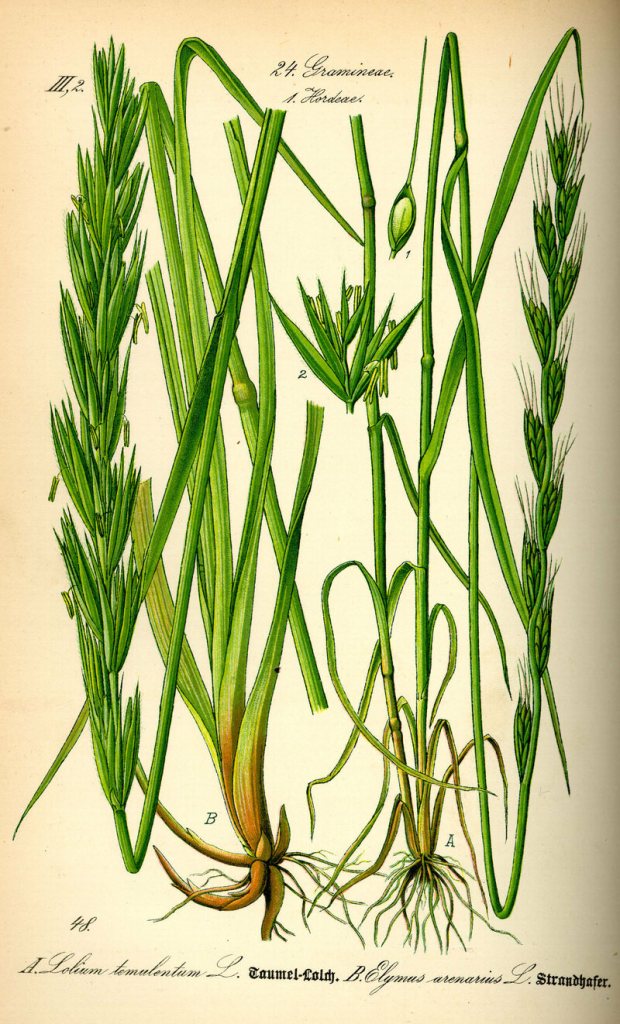
Darnel is a dangerous weed. It mimics wheat and so is difficult to identify from the good crop. It is a persuasive image of good whilst being the dire opposite and the effects are devastating. It cannot survive without assistance but it still reduces the value of the crop, hinders the progress of horticulture and increases the cost of agriculture. The weeds in our human harvest destroy lives whilst safeguarding their own. Darnel is a health hazard. It can be toxic to humans and animals. Howard Thomas, a professor of Biology, wrote in the Journal of Ethnobiology:
Where there is darnel, there is treachery and toxicity.
Throughout literature darnel has been a symbol of subversion. In the scripture it is sowed by the ‘enemy’. It even appears in my beloved King Lear when he is mad and emerges crowned with rank fumiter and furrow-weeds, With hordocks, hemlock, nettles, cuckoo-flowers,
Darnel, and all the idle weeds that grow. (4.4.2–5) We are subverted by those inspired by ‘the enemy’ which is the devil. Evil is most effective when it mimics good.
Darnel in small doses generates a euphoric state and has been used to give beer an extra ‘kick’. Just as we can desire a release from pain (physical, emotional, spiritual) darnel metaphorically sits there and offers us something we can not find within. This is where we lose sight of our innate goodness. If we cannot find it within then why are we pursuing it? We need to connect from within rather than trying to escape. How often do we seek physical gratification instead of spiritual?
My personal challenge from this passage is – what if I am darnel and not wheat? God tells us not to judge but we always do, it seems to be our default mode or system setting. Sometimes we say we don’t judge but how many times is that because we know we should not, but we still do (even a little). No matter how many times I restart my machine (so to speak) I always judge even though I know I shouldn’t. It is never suggested in the scriptural text but I’m going to draw a lengthy (and somewhat unliteral) bow – what if the wheat does not just die because of the darnel but what if the wheat becomes like darnel? If I am indeed wheat I would rather they went to the field and removed all that darnel. Assuming I am wheat. Not darnel. But I wont know, none of us will, until the harvest is gathered. Until then we just have to fight for the space in the soil, the nutrients, the water and most of all the light, for without the sunlight we will never grow.
Our scales are unbalanced
There has been much in recent years about gender equality. Women have more opportunities today than in previous centuries but still remain a minority in powerful decision-making positions. Society continues to prioritise men in many facets of life. Religion is probably one of the biggest boys clubs in the world. We have an all-male priesthood in the Catholic Church. Despite all the statements about human dignity and equality etc women remain restricted by gender. Women have challenged this and continue to raise their voices and their words to push towards that myth of equality. It is an interesting situation as not all female voices align. Indeed this challenge is raised by men and women, but not all.
This is the impact of the ‘boys-club’ mentality in society. For some the desire to have what men have been given is priceless and any cost will be paid. After a while these women become part of the boys-club and perpetuate the attitudes and behaviours as ‘they had to rise above them’ rather than changing from within the power circle. This does so much damage as they become a statistic to suggest that the ‘boys-club’ is past simply because women exist in their ranks. Some do not see gender inequality as important. I never used to see any issue with an all-male clergy for the first 3 decades of my life and it was from experiencing the negative impact of the boys-club that made me question the power structures surrounding me in my workplace, in my Church and in my community. To be fair I don’t actually think the boys club is a purely male thing – I think it is a social norm that a lot of people follow and there exist many advocates for equality who are male.
I think gender inequality goes against our faith. It goes against the teachings of Jesus and the philosophical traditions he followed.
There is a prayer in the Book of Judith in the Hebrew Scriptures:
Your strength does not lie in numbers,
nor your might in violent men;
since you are the God of the humble,
the help of the oppressed,
the support of the weak,
the refuge of the forsaken,
the saviour of the despairing.
Also too let us consider the first letter of John:
My dear people,
let us love one another
since love comes from God
and everyone who loves is begotten by God and knows God.
Anyone who fails to love can never have known God,
because God is love.
Both these passages reflect the nature of the divine as being grounded in love. John tells us that the essence of God is love. We aspire to be god-like in our actions and so we are called to act lovingly. Judith describes God as a divinity that walks with the downtrodden in times of trial. Neither of these texts places God on a throne giving commands, but a God who cares, who places wellbeing before accountability. This places the most powerful being, not as a micro-managing dictator, but a nurturer who walks with us when we need to sense support. If it is all supposed to germinate from love why then do those in power cling to power over kindness, to self-justification over truth, to tradition over inclusivity? What is the truth that is at the heart of our humanity that is not bound by race, colour, religion or gender?
There is a citation in a paper acknowledging the work of Karl Rahner from James F. Keenan in an article ‘Conscience in an Ethics of the Word’ about the importance of dialogue.
The best way we can find the truth is by leaving ourselves open to dialogue, humbly acknowledging that we may not know the truth as clearly we may think we know it. One practice would be to leave ourselves open to those who disagree with us. For they will help us see what in conscience we do not see (and vice versa).
James F Keenan, ‘Conscience in an Ethics of the Word’, Church (New York: National Catholic Life Center, Fall 2005) p.51
We talk about ‘breaking the glass ceiling’ but how about shattering the prejudicial walls that society continues to erect around women (and other minorities). Religion exists in society and ultimately, given all the philosophy of equality it espouses, perhaps it is valid to assert that religion conforms to social norms when it prioritises the male lens. We need men and women, the powerful and the humble, to engage in dialogue to derive a truth that is True for all of humanity, instead of bringing to the decision-making table like-minded individuals who are not going to change this situation and bring equality into our present.
Temptation
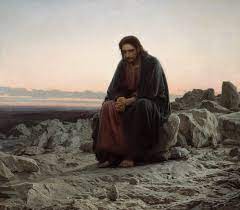
The temptation in the desert from the Gospels. Often we focus on the temptations (there are 3) and brush over the first part of the reading which informs us that Jesus was led by the Spirit. He was out in the wilderness for a purpose – he was fasting and praying to prepare himself to pursue his mission with passion.
The first temptation appears to be about physical comfort. He is fasting and therefore is logically hungry. But Jesus is fasting for a reason – remember he was led by the Spirit and is actively preparing himself, upskilling if you like, so he can be ready for the challenges ahead. Beyond the physicality of the ‘temptation’ it is also a distraction. The temptations are distractions from the goal.
Don’t we have this in our daily lives?
We aspire to be the best version of self and off we go to change the world and make it a better place. Then things come along that distract us from our goal to be positive world-changers. Perhaps we get drawn into the other temptations such as to power. There is a saying that power corrupts, and absolute power corrupts absolutely. How many of us have encountered people who perhaps are or were kind and benevolent to all at one point but with power have narrowed this perspective to a select group of humanity? This is a terrible temptation that seems to change the most people. Power is to be used for good but instead we see these narrow-minded cliques forming that minimize the positive impact.

The other temptation from the devil to Jesus was to test God. I think the contemporary version of this is to try and prove faith in a scientific way. We need to hold true to what is in our heart of hearts and not allow ourselves to be distracted from this core belief.
There are many temptations in life today. Each person is tempted by different things. Temptation usually leads us away from our own moral codes and is almost never a good thing when we give in to it. I can’t think of a time when a temptation has been good. Mostly things are called a temptation when they make us veer off the path that we ourselves have chosen or defined as good, honourable or desired.
So how do we resist? How did Jesus resist? We could say oh Jesus was divine its not a fair example, but Jesus was also human. What does he do? He put time and effort into doing some hard stuff to upskill and prepare himself for the task that lay ahead. He allowed himself to be led by the Spirit. This is not as easy as it sounds. We like to be in control. We listen to ourselves and those around us and sometimes we don’t hear the voice of God. It takes time and effort to hear.
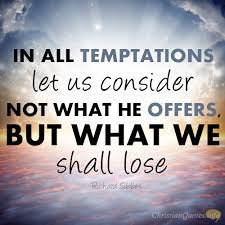
We often focus on the physical and ignore the spiritual. How many tomes of writing are there on healthy eating, exercise etc all focused on the body? We need this, but we need an equal balance of intellectual development and spiritual and emotional. As an entity we need to develop all components to be fully human and our best self. What we take in (not just food and drink) impacts how we think and feel.
To resist temptation, we need to know the path we wish to walk. Too often we accept a vague sense and don’t take the time to understand it clearly, without understanding how we can really commit. And how can someone resist the temptation to stray if one is not committed?
Clarity. Commitment. Resilience. Strength.
 The Female Theologian