
Look down

There is a particular kind of wisdom that begins by looking down.

Not in shame, not in fear, in attentiveness.

We spend so much of our lives looking ahead: toward the next task, the next relationship, the next crisis, the next version of ourselves we are hoping to become. We are encouraged to keep moving, keep climbing, keep improving. But Scripture, in its earthy way, often invites us first to notice where we are.

“Take off your sandals,” God says to Moses, “for the place where you are standing is holy ground.”

Before Moses is given a mission, before he is sent to Pharaoh, before he becomes a liberator, he is asked to become aware of the ground beneath his feet.

Holy ground is not always obvious. Sometimes it looks like wilderness. Sometimes it looks like grief. Sometimes it looks like the kitchen floor after an exasperating day, the hospital corridor, the classroom, the office where you swallow your words, the church pew where you wonder why you are there.

The ground on which we walk shapes us. Literally, yes. The places we inhabit form our bodies, our habits, our sense of what is possible. But there is also another kind of ground: the ground on which we stand metaphorically. The assumptions we carry. The histories we inherit. The privileges we may not notice. The wounds we protect. The theologies we were handed before we had language to question them.

To be spiritually awake is to become aware of both. It is to ask: What ground am I walking on? And also: What ground am I standing on? Because none of us stands nowhere.

We stand on family stories, cultural scripts, religious traditions, economic realities, racial histories, gendered expectations, and personal experiences of love or harm. We stand on what we have been taught about God, about ourselves, about whose voices matter, about whose pain is believable, about whose bodies are safe.

And so does everyone else.

This awareness should humble us. It should make us slower to condemn and quicker to listen. Not because every position is equally just or every belief equally harmless, but because people do not arrive at their convictions from thin air. They stand somewhere. Their fears and their hopes have roots. Their prejudices and their courage. Their silence and their resistance.

To understand the ground on which another person stands is not to excuse harm. It is to refuse shallow seeing. Jesus was remarkably attentive to ground. He noticed where people were standing socially, spiritually, and physically. He saw the woman at the well not merely as a Samaritan woman, but as someone standing at the intersection of gender, ethnicity, religious exclusion, thirst, and longing. He saw Zacchaeus not only as a tax collector, but as a man perched above the crowd, wealthy and isolated, complicit and curious. He saw the woman bent over for eighteen years and understood that her body, her community, and her dignity were all involved in her healing.

Jesus did not flatten people into issues. He met them on the ground where they stood, and then he invited them onto different ground. That is the work of love. Not sentimental love. Not love that avoids truth. But love that pays attention before it speaks. Love that asks what histories are present in the room. Love that knows liberation requires more than telling people to move; sometimes it requires naming the terrain, exposing the systems, and helping one another find solid footing.

This is especially important for those of us who speak of justice, faith, and transformation. We can become so certain of our destination that we forget to examine the ground beneath our own feet. We can critique others’ assumptions while leaving our own untouched. We can call for humility without practicing it. We can speak of the marginalized while standing comfortably at a distance from the cost of solidarity.

Awareness of our ground is not self-obsession. It is moral responsibility.

Where do I have stability that others have been denied?
Where have I mistaken my experience for universality?
Where has my theology been shaped more by comfort than by Christ?
Where am I standing on someone else’s displacement?
Where have I inherited ground I did not earn?

These are not easy questions. They are not meant to be. Holy ground often burns. But awareness is the beginning of reverence. And reverence changes the way we move.

When we know the ground is holy, we tread differently. We stop trampling. We stop assuming that speed is the same as faithfulness. We begin to notice whose footprints have been erased, whose labour made the path possible, whose bodies were buried beneath the road we now call progress.

And when we remember that others stand on complicated ground, we become more patient without becoming passive. We can challenge injustice while still seeing the humanity of those entangled in it. We can name harm clearly while understanding that transformation often requires more than argument. It requires encounter. It requires truth. It requires grace with a spine.

Perhaps this is part of what it means to walk humbly with our God. Not to walk timidly. Not to walk without conviction. But to walk with an awareness that the earth is layered, that every person is storied, and that God is already present in places we have not yet learned to recognize.

So before we rush forward, perhaps we might pause.

Look down.

Notice the ground.

Ask what it has carried. Ask what it has cost. Ask who stands beside us, and what they are standing on. Ask whether the place we occupy has made us more compassionate or merely more certain.

And then, barefoot if necessary, take the next faithful step.
Prayer

There is something quietly revealing about the way the word praying has drifted in ordinary speech. People say they are praying they get the promotion, praying their team wins, praying they get an apron on MasterChef, praying the rain holds off for the weekend. In that usage, praying has become a stronger synonym for hoping. It signals intensity. It adds drama. It suggests desire with a little extra emotional voltage. Yet for all its familiarity, that modern use of the word is thinner than the tradition from which it came.

Prayer, in the Christian sense, is not simply wanting something very much.

That is worth saying plainly, because language shapes theology more than we often realise. Once prayer is reduced to intensified wishing, God can begin to look like a cosmic dispenser of favourable outcomes, and the spiritual life can begin to resemble a celestial version of crossing one’s fingers. That is not the logic of Christian prayer. It is not the witness of Scripture. It is not the life of the saints. It is not the pattern given to the Church by Christ.

The older texture of the word is much richer. To pray once meant, quite simply, to ask. One still hears the echo of it in old literature: pray continue, I pray you, pray tell. There, the word does not yet carry the narrowed meaning of private religious devotion alone. It suggests entreaty, appeal, request, a turning of oneself toward another in dependence and seriousness. Even in that older ordinary sense, prayer already contained something relational. One did not merely generate a wish internally. One addressed someone. One stood in need. One turned outward.

Christianity did not abolish that meaning. It deepened it.

To pray is to address God, yes. Yet even that needs care. Prayer is not merely the presentation of a shopping list to heaven. It is the placing of the self before God. It is attention before it is acquisition. It is relationship before it is result. It is, more fundamentally, the movement of the creature toward the Creator in trust, honesty, dependence, praise, sorrow, gratitude, longing, repentance, adoration, and love.

That is why the reduction of prayer to wishing feels so spiritually misleading. Wishing is often self-enclosed. Prayer is Godward. Wishing remains at the level of desire. Prayer can transform desire. Wishing says, I want this outcome. Prayer says, Here I am, Lord, with all that I want, fear, hope, and lack. Hold it, judge it, purify it, and teach me how to desire rightly.

Those are not the same thing.

The difference matters because the Christian life is not built around getting the outcomes one prefers. It is built around communion with God. The purpose of prayer is not to make God compliant with our plans. The purpose of prayer is to draw us into deeper union with the God who is not an accessory to our ambitions. Prayer may include petition, because God cares about the details of human life. The Gospels give no basis for pretending otherwise. People cry out for healing, for mercy, for bread, for help, for deliverance. Christ does not rebuke every request as immature. Need can be holy when it is brought truthfully before God.

That is why the Lord’s Prayer remains so decisive. Jesus teaches his disciples to ask: daily bread, forgiveness, deliverance from evil. Christianity is not embarrassed by the fact that human beings ache, hunger, fear, and ask. These petitions are framed by something larger: hallowed be thy name, thy kingdom come, thy will be done. Prayer begins in God’s holiness and ends in God’s will. It does not begin in the self and end in self-satisfaction.

That is a very different thing from saying one is praying to get an apron on MasterChef.

Of course, people usually mean no great theological claim by such phrases. Most are speaking lightly, playfully, colloquially. Language evolves. Words loosen. Religious vocabulary migrates into secular speech all the time. That in itself is not cause for panic. Yet there is still something worth noticing here. When prayer becomes merely another word for wishing, the human person subtly forgets what prayer is for. Prayer becomes outcome-centred rather than God-centred. It becomes transactional rather than relational.

One might say that wishing tries to secure a future, while prayer entrusts the future.

That distinction also protects us from one of the cruellest spiritual confusions: the idea that unanswered prayer means failed prayer. If prayer is basically wishing directed upward, then its success can only be measured by whether the wished-for thing arrives. In that framework, no apron means no answer, no healing means no presence, no changed circumstances mean no God. Some of the deepest prayers in Scripture are not prayers that alter the immediate outcome. They are prayers that reveal fidelity in the midst of anguish. The Psalms do this repeatedly. Gethsemane does this with unbearable force. Christ prays not as one performing a magical technique for evading suffering, but as the Son who places even agony before the Father: not my will, but yours.

That is prayer in its starkest form. Not denial. Not passivity. Not polished acceptance. Relationship under pressure. Trust under strain. Love refusing to sever itself from God even when the path ahead is dark.

Seen in that light, prayer is far more demanding than wishing. Wishing asks very little of us beyond desire. Prayer asks honesty. Prayer asks humility. Prayer asks time. Prayer asks that we come before God not only with what we want, but with who we are. Prayer is not a decorative spiritual habit attached to life’s real concerns. Prayer is where life is most truthfully brought.

Perhaps that is why the saints always seem to speak of prayer with such gravity and such tenderness. They understand that prayer is not chiefly a technique for acquiring favoured circumstances. It is the slow schooling of the heart in the presence of God. It is how desire is reordered and how illusions are exposed. It is how gratitude is learned and it is how sorrow is carried.

Sometimes prayer does include asking for particular things. It would be strange, and perhaps a little prideful, to suggest otherwise. One may pray for health, for work, for a child, for peace, for reconciliation, for the safe return of someone beloved. One may pray before surgery, before an interview, before results are released, before a conversation one dreads. One may pray in need, because dependence on God is not a failure of maturity but one of its signs. The problem is not that Christians ask. The problem is that modern speech often imagines asking is the whole thing.

It is not.

Prayer is not wishing with religious language draped over it. It is not superstition for respectable people. It is not the attempt to pressure God into providing a preferred storyline. Prayer is, at heart, the turning of the soul toward God who is God. That means prayer may contain desire, but it cannot be reduced to desire. It may contain petition, but it cannot be reduced to petition. It may contain hope, but it cannot be reduced to hope for one specific outcome.

Prayer is communion before it is request.

That is why a person can pray and still not receive the thing they asked for. The fruit of prayer is not always found in altered circumstances. Sometimes it is found in being made more spacious, more truthful, less frantic, less self-enclosed, more able to endure, more able to adore, more able to trust that God remains God even when life is not giving us what we would have chosen.

Modern speech will probably keep using praying as shorthand for intense hope. Language tends to do that. It scavenges from sacred vocabulary because sacred vocabulary still carries force. But I think that prayer deserves better than to become a pious synonym for wishful thinking. It belongs to a larger vision of the human person: needy yet beloved, finite yet addressed by God, desiring yet called beyond desire into worship.

So no, prayer is not really what one does in order to get an apron on MasterChef. Prayer is what one does in order to remain turned toward God whether one gets the apron or not.

The netball lesson

In Australia, netball has long been woven into the fabric of communal life. It has been played in parish schools, local clubs, and community associations for generations. It has formed girls and women in skill, discipline, resilience, and loyalty, often without fanfare. It has given people not merely a sport, but a place to stand. There is something worth noticing in that. Modern life is increasingly fragmented. People drift easily. Commitments are provisional. Belonging is thin. Many relationships remain at the level of acquaintance. Netball resists that drift, at least for a while. It asks something of you. It requires presence. It teaches that you cannot simply orbit a team at a distance and still expect the game to hold.

That feels spiritually significant.

Christian theology insists that the human person is not made for isolated self-construction. We are relational creatures because we are created by a relational God. The doctrine of the Trinity is not an abstract puzzle for specialists. It is, among other things, a way of saying that reality itself is marked by communion. God is not solitary. God is love, and love always moves outward in self-gift, mutuality, and presence. To be made in the image of that God means that we become most fully ourselves not in sealed independence, but in rightly ordered relationship. We are shaped through love, obligation, sacrifice, forgiveness, and shared purpose. A good netball team knows this instinctively.

No one wins a netball game alone. The sport simply will not allow the fantasy. The rules themselves resist individual domination. You cannot occupy every space. You cannot do every job. You must pass. You must trust. You must move at the right moment and hold back at the right moment. You must know where you end and where another begins. Even the most gifted player depends upon others creating space, reading the play, defending bravely, and offering an option when pressure closes in. Talent matters, certainly. So does fitness. So does vision. Yet none of it is enough without the discipline of belonging to the whole.

That is not far from St Paul. When Paul writes of the Church as the body of Christ, he is offering more than a pleasant metaphor about cooperation. He is making a theological claim about interdependence. The body does not consist of one member but of many. Every member matters, not because every member does the same thing, but because each has a distinct part in the life of the whole. The eye is not the hand. The hand is not the foot. Difference is not a threat to unity. It is part of what makes unity possible. A body is not formed by sameness. A body is formed by coordinated belonging.

Netball, at its best, teaches something similar. The goal shooter is not the wing defence. The centre is not the goalkeeper. Each role carries its own discipline, vision, and responsibility. Some positions are highly visible. Some do indispensable work that rarely makes the highlight reel. Some players are asked to steady the team when momentum slips. Some absorb pressure. Some create possibility. Some score. All of it matters. A team begins to fail when people start treating one another as interchangeable, or when visibility is confused with value.

Faith communities fail in much the same way. Churches are often tempted by a distorted imagination of importance. Some forms of service are praised because they are public. Some gifts are overlooked because they are quiet. Some people are assumed to matter more because they stand at the front, speak into microphones, or carry recognised authority. Yet the life of the Church has always depended just as much on the ones who pray faithfully, welcome gently, notice suffering quickly, prepare meals, sit beside the grieving, teach children, arrange flowers, stack chairs, visit the lonely, and keep showing up when no one thinks to applaud them. The kingdom of God has never been built by charisma alone. It has always also been built by hidden fidelity. That, too, is a netball lesson.

Anyone who has spent time around a committed team knows that games are not won only by brilliance. They are often won by trust, by repetition, by unglamorous discipline, by the player who tracks back one more time, by the person who does her job when tired, by the one who keeps communicating when the game becomes scrappy, by the quiet steadiness that prevents collapse. Spectacle gets attention. Reliability builds the team.

There is also something deeply revealing in the way netball teaches limits. No player can go everywhere. Court boundaries matter. Positioning matters. Overstepping matters. There is, strangely enough, a kind of humility built into the game. You learn quickly that you are not meant to be everything. You are responsible for your part, not for the whole court. There is freedom in that. Much human exhaustion comes from the belief that worth depends on omnipresence, that love means being endlessly available, that leadership means carrying everything at once. Netball exposes the absurdity of that illusion. Healthy teams require each person to inhabit their role well while trusting others to inhabit theirs. A mature faith community should look something like that.

The Church is not strengthened when one person becomes indispensable. It is strengthened when the gifts of many are recognised, invited, and woven together. Christian community should never be a stage for heroic individualism. It should be a place where burdens are shared, where people are formed to give and receive, where no one is asked to be the Messiah because Christ already is. There is enormous spiritual relief in communities that understand this. Such communities do not collapse when one person is absent. They know how to hold one another up. They know how to make room. They know that the grace of God is often mediated through ordinary, distributed faithfulness.

This matters especially in Australia, where community sport has often done quiet cultural work that institutions themselves sometimes struggle to do. Netball clubs and school teams have, for many girls and women in particular, been places of confidence, identity, and belonging. They have offered intergenerational community. They have created local rituals. They have held people through adolescence, motherhood, grief, transition, and change. They have been one of the places where people learn that they are not alone. That should not be romanticised too easily; sport can wound as well as form. Yet at its best, it offers a small but real witness against individualism. It says: your life touches other lives. Your effort matters to someone else. Your absence is felt. Your presence strengthens the whole.

Correspondingly, a faith community is not simply a gathering of religious individuals who happen to believe adjacent things. It is meant to be a body. It is meant to be a communion. It is meant to be a people who learn, slowly and imperfectly, how to move in relation to one another under the gaze of God. It is where we practise encouragement, forgiveness, patience, courage, and mutual care. It is where we discover that spiritual maturity is not measured only by private conviction, but also by whether we know how to remain in loving relationship when things are inconvenient, demanding, or imperfect. Solitary spirituality will always be tempted by self-deception. Community reveals us more truthfully. It shows us where we are generous and where we are brittle. It teaches us whether we know how to pass, to wait, to trust, to support, to celebrate another person’s success without resentment.

Perhaps that is why netball can feel like more than netball. A court can become, in its own modest way, a place of moral and spiritual formation. Not because sport saves us. Not because teamwork is the gospel. Not because faith should be reduced to positive lessons from games. Rather, because grace often discloses itself through the ordinary patterns of creaturely life. Christianity has always believed that the visible world can teach us how to see more deeply. Human community, with all its mess and discipline and beauty, can also become a place where deeper truths are glimpsed.

A netball team reminds us that belonging is costly and beautiful. It reminds us that gifts differ. It reminds us that no one flourishes alone. It reminds us that trust must be practised before it can be relied upon. It reminds us that presence matters. It reminds us that the whole is strengthened when each person offers what they have for the sake of something shared. A faithful church community should do the same.

Perhaps that is the quiet invitation beneath both sport and discipleship: to become people who know how to play our part with humility, courage, and generosity; to become people who do not cling to the ball of our own importance; to become people who understand that life is received and given in relationship; to become, by grace, a community in which others can move more freely because we were there.

That is not a bad theological lesson to learn on an Australian netball court.

Unseen

There is a loneliness that does not come from being alone, but from being surrounded. It is possible to be competent, present, and outwardly fine, and still feel as though no one has really noticed you. Not simply noticed that you are there, but seen with the kind of attention that recognizes weight without demanding explanation.

That kind of hiddenness can hurt more than we admit. It teaches people to keep functioning, to stay useful, to speak fluently in the language of ‘I’m fine.’ But Scripture gives us a God who is not deceived by composure. Hagar, abandoned in the wilderness, names Him as the God who sees her (Genesis). In that moment, we are given something essential: divine love is attentive. God does not only see the important, the articulate, or the obvious. He sees the overlooked.

This pattern continues in Christ. Jesus notices people before they can present themselves well. He sees Zacchaeus in the tree, Nathanael under the fig tree, the widow with her two coins, the hemorrhaging woman in the crowd. Again and again, the Gospels show us a Lord whose love takes the form of attention. He is not drawn only to suffering that has already found words. He is attentive also to the sorrow that has gone quiet.

And perhaps that is where pastoral care begins.

We often imagine care beginning when someone finally asks for help. But some of the most healing care begins earlier than that: when someone notices. A changed tone. A tired face. An unusual silence. Not as intrusion, and not as performance, but as the fruit of love that has learned to pay attention. To say, gently, ‘You seem quieter than usual,’ or ‘You came to mind today,’ is sometimes to offer a person the mercy of not having to wave for help before being remembered.

There is something deeply Christian about that kind of attentiveness. The Good Shepherd knows His sheep personally, not abstractly. The Church, too, is meant to be more than a crowd standing near Christ. ‘If one member suffers, all suffer together’ (1 Corinthians). To notice one another is not sentimental. It is part of what it means to belong to one another in Him.

Catholic life has always understood that grace comes through mediation: water, oil, bread, wine, touch, words. So too, God’s care often reaches us through human presence: through a timely message, a patient silence, a question asked without pressure, a kindness that does not require full disclosure before it becomes tender. Grace does not bypass us. Very often, it arrives through the careful attention of another person.

And for those who feel unseen, there is hope here too. Your hiddenness is not emptiness. Your suffering does not become real only when someone else finally notices it. The Lord has already seen you fully. ‘Your Father who sees in secret’ (Matthew) is attentive not only to prayer, but to the one praying, to the ache not yet spoken, the fear not yet named, the weariness carried quietly.

To be seen without having to ask is one of the gentlest forms of mercy. It reminds us that we are not background, not function, not interruption, but persons worthy of reverence. And in a world full of many people and very little noticing, that kind of attention can become a form of pastoral care, the kind that helps the heart believe it was never invisible at all.

Humble feet

There is something deeply human about feet.

They are not especially glamorous, so yes I am ignoring those who fastidiously prepare them at the nail salon. No one writes sonnets to them. They are rarely the part of ourselves we present first to the world. And yet they carry everything. They bear weight. They absorb pressure. They harden, ache, blister, and keep going. Long after the mind is tired and the heart is unsure, the feet still have to find the ground and take the next step.

That is part of what makes John’s account of the washing of the feet so arresting. Jesus does not reach first for the heads of his disciples, as though holiness were mainly about right ideas. He does not take their hands, as though discipleship were only about what they can do. He kneels instead at their feet: the place marked by movement, fatigue, dust, and the ordinary evidence of a life lived on the road.

And in doing so, he touches the part of them that has been with them everywhere.

Feet know where we have been. They know the roads we would rather forget, the wandering, the hesitation, the running away, the trudging return. They know the daily commute of an ordinary life and the longer journeys that change us. They carry grief into hospitals, joy into wedding receptions, dread into meeting rooms, and hope into churches. They are present in all our becoming. We do not float through our lives. We arrive somewhere by the wear and effort of our feet.

That matters in John’s Gospel, because this is no random gesture of kindness. It is intimate, confronting, and culturally loaded. In the world of first-century Palestine, feet were filthy. People walked dusty roads in sandals, through streets shared not only with crowds but with animals and all that came with them. Washing feet was a practical necessity of hospitality, but it was lowly work. It belonged to servants. It was the task associated with statuslessness, with stooping, with taking on what others would prefer not to touch.

Which means that when Jesus rises from the table, removes his outer robe, wraps a towel around himself, and begins to wash the disciples’ feet, he is not performing a quaint ritual of niceness. He is overturning assumptions about power, dignity, and God.

This is what is so extraordinary: the one whom they call Lord bends down to the dustiest part of them.

And perhaps that is still what startles us. We are often content with a God who remains impressive, elevated, safely above the mess. A God of height, perhaps, but not always of nearness. Yet here in John, Jesus insists on coming close not to the polished or the composed, but to the worn and road-marked places. He does not love his disciples in the abstract. He loves them in the grit of their actual lives.

Peter, of course, recoils. That too feels deeply human. There is something uncomfortable about being served in the places where we feel least dignified. It is one thing to let God near our strengths, our talents, the parts of ourselves we can present with confidence. It is another to let him kneel before our tiredness, our accumulated dust, our vulnerability, our need. Peter’s refusal is not just modesty. It is the protest of someone who does not yet understand a love humble enough to stoop.

But this is precisely the shape of divine love in John’s Gospel. It is not distant. It is incarnational. It gets close enough to touch the road on us.

And that road matters. Because the feet Jesus washes are not generic feet. They belong to particular men with particular journeys. Feet that have followed him, however imperfectly. Feet that will soon scatter in fear. Feet that have stood in confusion, walked beside miracles, and hesitated on the edge of understanding. One pair belongs to Peter, who will deny him. Another belongs to Judas, who will betray him. Jesus washes them anyway.

That detail should stop us.

He washes the feet of the faithful and the faltering.
The devoted and the fractured.
The ones who will remain and the ones who will fail.

So often we imagine holiness as reward for getting the journey right. But the Gospel suggests something else: Christ’s love meets us in the journey itself, with all its dust and detours. He is not waiting at the finish line, arms folded, for a perfected version of us to arrive. He kneels in the middle of the road.

There is, too, something profoundly contemporary about that image. Ours is a culture that often celebrates polish over depth, platform over presence, and performance over service. We curate ourselves carefully. We learn to display the parts of our lives that look composed and purposeful. But feet tell the truth. They speak of pressure and pace. They reveal that life is not lived as an aesthetic, but as effort. To wash feet, then, is to honour not image, but reality. It is to attend to the human person where life has actually left its mark.

Perhaps that is one reason the Church returns to this Gospel in Holy Week. Not because it is sentimental, but because it reveals what love looks like when it becomes flesh and action. Not abstract care, but kneeling care. Not affection from afar, but service with a towel and basin. It is love willing to touch what is tired, sore, and unadorned.

And it quietly asks something of us.

If Jesus can kneel before the feet of others, then Christian discipleship cannot be built on superiority. It cannot be sustained by prestige, self-importance, or the need to remain above the ordinary burdens of other people. To follow Christ is to become the sort of person who is not afraid of another’s dust. It is to serve not only when service is visible or rewarding, but when it is hidden, practical, and humble.

Sometimes that looks dramatic. More often, it does not. It looks like tending gently to another person’s weariness. It looks like making room for the one who is struggling to keep up. It is evident when we treat others with humanity instead of allowing preference to tailor our response. It looks like noticing when someone’s journey has been harder than they are letting on. It looks like resisting the temptation to measure people by how impressive they appear, and instead reverencing the fact that they have been carrying a life.

Because everyone is carrying one.

Everyone has feet that have taken them through things.
Through grief.
Through change.
Through private disappointments.
Through responsibilities no one else fully sees.
Through hope, even when hope felt costly.

And maybe that is part of the holiness of this scene: Jesus does not ask first for an account of the journey. He does not demand explanation before he serves. He simply kneels and begins.

There is a tenderness in that which the world does not often know how to value. But Christianity should. The washing of the feet tells us something essential about God: that divine love is not embarrassed by our humanity. Not by its dust, its limits, its tiredness, or its need. God comes that close.

So perhaps the invitation of this Gospel is not only to admire Jesus’ humility, but to let ourselves be met by it. To allow Christ near the road-worn places. To trust that what has carried us, however imperfectly, is not beneath his attention. And then, having been loved like that, to go and love others in the same way.

After all, feet are where the journey shows.

And in John’s Gospel, they are also where grace kneels.

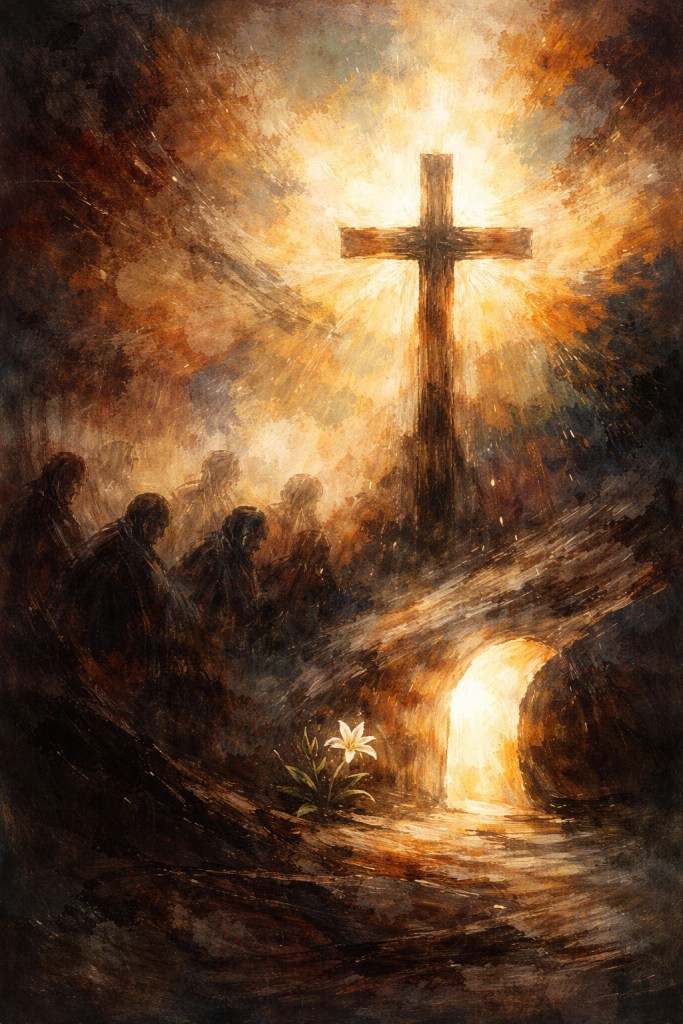
Easter Reflection

Soon the Paschal Triduum will be upon and around us. It is important, I think, not to rush through the brutality of Good Friday because we know that Sunday is coming.  Good Friday is devastating. And on this day, we are not asked to explain that devastation away. We are invited instead to sit in it, to pray in the discomfort, and to resist the urge to make the cross more palatable than it is.

That feels especially important now, because there is still so much in our world that ought to make us uncomfortable. We may not witness public executions in the town square, but betrayal is everywhere. Humiliation has become a form of entertainment. Rejection is so common that many barely know how to name it anymore. We scroll past suffering, filter it, anaesthetise it, soundtrack it, and move on. But the cross does not let us move on so easily. It asks us to look again. To look longer. To see the world as it is, without tinted glasses.

And it is devastating.

But Easter is the holy insistence that brutality will not have the final word.

When the Risen Christ returns to the disciples he still bears the wounds. The wounds are not hidden. They are transfigured. Good Friday was not a passing shadow. Resurrection, then, is not the cancellation of the cross, but God’s vindication of the one who was crucified, and in him, of all those whose lives are crucified by injustice, grief, exclusion, and loss. It is God’s decisive declaration that suffering and sin do not have ultimate claim over human history. The Resurrection reveals that even in a world marked by brutality, grace is still at work, and life remains open to God’s future.

This is part of what makes Easter hope so compelling, and so necessary, especially for those of us who work with young people. They are still becoming. Still being formed. Still learning how to live with disappointment, grief, anxiety, failure, exclusion, uncertainty, and all the smaller deaths that come before the larger ones. And what they need from us is not shallow reassurance or borrowed motivational slogans. They need hope.

They need Christian hope: the kind that can look honestly at darkness and still say, this is not the end. The kind that teaches them that grief is real, but so is joy. That wounds matter, but they do not have the authority to tell the whole story. That life can return in places that seemed closed over. That what looked sealed shut may yet be broken open by grace.

This is why Easter joy is never superficial. It is not a brightness laid over sorrow, nor a brief reprieve from the weight of the world. It is joy born of the Resurrection of the crucified Christ. And because it is resurrection joy, it is marked by truthfulness. It does not turn away from suffering, nor does it sentimentalise it. It knows what human cruelty can do. It has passed through abandonment, humiliation, violence, and death. Easter joy is hard-won because it is the joy of the God who has entered the depths of human pain and has not allowed death to be sovereign there.

This is why joy can emerge in places where it should not, by ordinary logic, have been possible. A laugh after grief. Courage after fear. Tenderness after loss. The quiet strength to continue loving when the world gives you every reason to retreat into numbness. These are not decorative emotions or passing consolations. They are small, luminous, stubborn signs that death does not reign without contest. They are traces of resurrection within history, moments in which the life of God presses against all that diminishes human life.

In schools especially, this matters. Young people do not need a faith that shields them from sorrow by offering easy reassurances or thin optimism. They need to be initiated into hope. They need to know that Christian hope is not denial, but trust in the God who brings life out of what seems lost, meaning out of what seems broken, and possibility out of what appears closed. And so, when real joy appears we should help them recognise it for what it is. Not a distraction from serious faith, but one of its deepest fruits.

So as we move through Easter, perhaps the invitation is not simply to affirm the Resurrection as doctrine, important though that is, but to live as resurrection people: people who resist despair, who remain faithful to the wounded, who refuse to concede the world to death, and who trust that God is still at work in the midst of history.

We can affirm that grace still rises within history.

That even now, life is being drawn out of what looked lost.

And that is glory indeed.

The Good Samaritan

I recently participated in a Synod retreat and was gifted with time and momentum to pray some scripture. From the second one these thoughts arose after praying The Good Samaritan from the Gospel of Luke.

There is something unsettling about the question that opens the parable of the Good Samaritan. The expert in the law stands up, not empty-handed, but already armed with knowledge. He knows the tradition. He knows the commandment. He knows the right language, the right nuances, the right inflexions. And perhaps that is what makes him so familiar. He is not difficult to recognise. He may well be us. He may be the Church. He may be those of us who know the prayers, attend regularly, speak fluently of love of God and neighbour, and yet still find ourselves asking the evasive question: And who is my neighbour?

It is a dangerous question, not because it seeks truth, but because it seeks boundaries. Jesus answers not with a definition, but with a story.

In Luke’s Gospel, the man is travelling from Jerusalem to Jericho. Jerusalem is not just another city. It is the holy city, the centre of worship, the place of temple, sacrifice, covenant, and divine encounter. Jerusalem represents the sacred centre, it is the holy of holies, the place where God is named, remembered, and ritually encountered. Jericho, by contrast, is not necessarily evil, but it is away from that centre. It can be read symbolically as the ordinary world, the world of commerce, routine, distraction, and exposure. A place to buy and to sell. The journey from Jerusalem to Jericho can therefore be understood as a movement from the sacred into the everyday, from what is consciously holy into the spaces where holiness is less obvious. That movement feels achingly contemporary. We too move constantly from what is named holy into places that feel spiritually unguarded: the online world, social spaces of performance and comparison, relational margins, places where identity is fragile and belonging uncertain. If Jerusalem is the place of remembered meaning, Jericho may well be the ordinary world in which meaning is contested, thinned out, or lost. Eliade’s language of the sacred and the profane is helpful here. The road is that in-between place where the sacred memory of who we are is threatened by the profane pressures of a fractured world.

And it is on that road that the man is attacked.

Today, that road may be many things. It may be the online world, where identity is relentlessly exposed to comparison, judgement, manipulation, and performance. It may be social margins, where people feel unseen, excluded, or unprotected. It may be the wider culture, where transcendence is dimmed and everything is flattened into opinion, speed, consumption, and self-construction. The road is wherever the soul becomes vulnerable once it leaves the places where meaning feels secure.

And on that road there are robbers looking to take what is valuable.

The robbers may be all those forces that prey upon the vulnerable, especially spiritually vulnerable people. They are whatever strips a person of dignity, clarity, hope, and belonging. In the case of young people, this might include online cruelty, predatory ideologies, addictive distraction, shallow affirmation, consumerism, nihilism, loneliness, and the pressure to become an image rather than a person. The robbers are the forces that take hold of fragility and exploit it. They do not always appear violent at first. Often they look attractive, persuasive, or normal. But in the end they leave a person diminished.

Perhaps the most piercing way to read this now is not as a physical assault, but as a spiritual one. Our young people, especially, know what it is to be beaten without bruises. They are robbed in quieter ways. Robbed of confidence. Robbed of hope. Robbed of interior stillness. Robbed of the capacity to trust that they are more than performance, image, success, or failure. The robbers are all those forces that prey upon vulnerability: shame, cynicism, contempt, false belonging, addictive distraction, exploitation, ideologies of worthlessness, the constant demand to curate a self rather than inhabit a soul. These do not always appear violent. Often they arrive clothed as freedom, affirmation, entertainment, or relevance. But they leave a person stripped. Bare. Unshielded. Vulnerable.

And what are the wounds?

Doubt, certainly. Not honest questioning, which can be holy, but the more corrosive doubt that whispers that nothing is true, nothing is trustworthy, nothing is worth giving yourself to. Then apathy: that terrible spiritual numbness of being left half dead. Apathy is not dramatic. It is colder than rebellion. It is the slow surrender of desire. It is the inability to care, to hope, to pray, to seek, to love. A young person need not be loudly opposed to God to be spiritually wounded. Sometimes they are simply exhausted, unconvinced that anything holy could possibly reach them where they lie.

And then come the religious figures.

This is where the parable becomes particularly challenging for religious people. Both figures are associated with worship, temple life, and religious duty. They are not outsiders to God. They are insiders. Yet both pass by. Why? The text does not fully explain. Perhaps they fear impurity. Perhaps they fear inconvenience. Perhaps they are preoccupied with duty. Perhaps they do not want to become entangled. The reason matters less than the result: they do not draw near to the wounded man.

This is an uncomfortable image for the Church. It suggests that it is possible to be close to sacred structures while remaining distant from the spiritually wounded. It is possible to preserve forms of religion while failing in mercy. Form without spirit. It is possible to know the law and yet not love. The letter of the law unwarmed by the spirit of the law. When we think about declining church attendance, especially among young people, this becomes painfully relevant. One of the questions the parable presses upon us is whether the Church has sometimes been more like the priest and the Levite than we would care to admit. Have we seen the wounds of the young and offered judgement instead of tenderness? Have we responded to doubt with fear rather than accompaniment? Have we mistaken instruction for healing? Have we stayed loyal to the sacred centre while failing to walk the dangerous road where people are actually bleeding? A failure of nearness. The scandal of the parable is not only that a Samaritan helps, but that the officially faithful do not.

And so we must ask, with some honesty: where has the Church crossed the road? Where have the faithful seen the spiritual wounds of the young and kept moving? Where have we mistaken moral commentary for compassion, strategy for accompaniment, correctness for love? Where have we been so busy protecting Jerusalem that we have abandoned those bleeding on the road to Jericho?

Then comes the Samaritan.

This is the shock in the story. Samaritans and Jews were not simply different groups; there was deep hostility and suspicion between them. The Samaritan is not the expected hero. He is the religious and cultural outsider. He is the one the original hearers may have been least inclined to admire. That is precisely the point. Mercy appears from an unexpected place. The one who stops is the outsider. The excluded one. The one regarded with suspicion. The enemy. Which means, perhaps, that grace does not always arrive wearing the garments we expect. Perhaps the Samaritan is found among those excluded from the Church, those who have been dismissed, wounded, or pushed to the edges, and yet who still know how to kneel beside suffering. Perhaps the Samaritan is the person the religious centre has mistrusted, but who nevertheless acts with the very mercy of God. That should humble us. It may even save us.

This opens an important possibility for reflection today. If the Samaritan is the outsider who acts with compassion, then perhaps he can represent those who are excluded from the Church, those on the margins, those whose presence has not always been welcomed, those whose voices have not always been trusted, and yet who may embody mercy more clearly than those at the centre. That is not a romanticising of exclusion; it is a challenge to religious complacency. Sometimes those we assume to be outside grace become the very people through whom grace is revealed.

And yet the Samaritan is more than a social outsider. He is also a Christ figure. He sees the wounded man, is moved with compassion, comes near, binds wounds, pours on oil and wine, lifts him up, carries him to shelter, and pays for his continued care. Every movement is one of nearness and cost. He does not analyse the man from afar. He does not reduce him to a problem. He does not ask whether he deserves help. He acts to restore life.

This matters enormously if we are reading the parable through the lens of spiritual injury. Christ is the one who comes toward those left for dead by the world. He does not wait until they can stand on their own. He does not require perfect belief before tending their wounds. He meets people in their doubt, in their numbness, in their fragmentation. He is concerned not simply with rule-keeping, but with restoration.

That means the Church, if it is truly to follow Christ, cannot remain only in Jerusalem. It cannot remain satisfied with guarding sacred language while people suffer on the road. It must go out onto the road to Jericho. It must enter the ordinary, fractured, profane places where spiritual wounds now occur. It must be present online, at the margins, in the places of confusion, exhaustion, and alienation. It must become credible not first by arguments, but by mercy. Not by abandoning truth, but by embodying it as love.

The young in particular need this. They are often spoken about as though the issue were simply attendance, numbers, disengagement, or cultural change. But the parable invites a deeper reading. Perhaps some are not absent because they are indifferent in a shallow sense, but because they have been wounded. Perhaps behind disengagement there is doubt. Behind silence there is shame. Behind apathy there is exhaustion. Behind rejection there is the ache of never having been met with compassion. If so, then the response cannot merely be to demand return. It must be to tend wounds.

The genius of the parable is that Jesus changes the question. The expert in the law asks, ‘Who is my neighbour?’ as though neighbour were a category to be identified. But Jesus ends by asking which of the three proved neighbour to the wounded man. In other words, the issue is not first who qualifies to receive love. The issue is whether we ourselves are willing to become people of mercy and show love. It becomes about us not them.

That is the challenge.

And perhaps the question for our time is this: Who is lying wounded on the road now?

It may indeed be our young people. Spiritually bruised by doubt. Left half dead by apathy. Stripped by a world that knows how to market identity but not how to nourish the soul. If so, the call of this Gospel is not first to argument, nor to nostalgia, nor to lament about declining attendance. It is to mercy. To nearness. To oil and wine. To the patient, unglamorous work of tending spiritual wounds with truth, presence, listening, beauty, prayer, and love.

The Church cannot merely stand in Jerusalem speaking of holiness. It must walk the road. It must risk Jericho. It must enter the profane spaces where people are actually wounded. Online. At the margins. In confusion. In disillusionment. In exhaustion. In silence. For that is where Christ is found bending low.

The parable does not permit us the comfort of asking who belongs inside. It asks instead whether we are willing to become neighbour where life has been assaulted. And perhaps that is the deepest wound of all in our age: not only that many are beaten by doubt and apathy, but that too few believe anyone will stop.

Christ stops.

And if the Church is truly his body, then we must stop too.t the sacred from a distance, but to walk the dangerous road, to recognise spiritual wounds for what they are, and to believe that doubt and apathy are not signs of failure so much as injuries in need of mercy. The question is no longer only who the neighbour is. The question is whether we will stop.

Jesus Has a Soul

It is a slightly alarming feature of theology that one can know something perfectly well and still be startled by it in the middle of a hymn. Soul of my Saviour, sanctify my breast. Entirely familiar. Entirely orthodox. And yet, there it was, arriving with unnecessary force: Jesus has a soul.

Which is obvious, until it isn’t.

Perhaps because we are used to speaking about Jesus in doctrinal shorthand. Fully divine. Fully human. Word made flesh. All true. All essential. But sometimes those phrases become so polished they stop catching the light. We affirm the Incarnation while skating past its density. Jesus did not merely take on a body. He took on a human life from the inside. A human mind, a human will, human affections, human suffering and human prayer. Which means, plainly enough, a human soul.

Not humanity as costume. Not flesh as a temporary prop. Not God doing an admirable approximation of embodiment. Christianity makes the much stranger and greater claim that the Son assumed the fullness of human nature. If something essential to being human were missing, then the Incarnation would be thinner than the Church says it is, and salvation would start to look suspiciously partial.

A human being is not a body alone. Human nature includes a rational soul. So if Christ is truly human, Christ truly has a human soul. This is not an ornamental detail for people who enjoy theological footnotes. It belongs to the logic of the thing.

And it sharpens the Gospels in rather arresting ways.

When Jesus is troubled, this is not theatre. When he grieves, this is not a divine demonstration piece. When he prays in Gethsemane in anguish, asking that the cup might pass, this is not God pretending to be distressed for our pedagogical benefit. It is the Son living a fully human life, not from a safe height above it, but from within it.

That matters for prayer more than we usually admit. Because prayer is often introduced as though it begins in stillness, maturity, and admirable composure. In practice, it usually begins because something in us has become too heavy to carry alone. We pray because we are afraid, or tired, or heartsore, or unable to think our way out of what hurts. Much prayer is not the overflow of serenity. It is what the soul does when it can no longer survive on self-sufficiency.

And here the fact that Jesus has a soul becomes more than a doctrinal correctness point. It becomes consolation.

When we pray to God, we are not addressing a distant divine intelligence who understands suffering in principle. In Christ, God knows the interior life from within. He knows dread before words form. He knows sorrow that exhausts language. He knows the strange pressure of love and grief and obedience meeting in one soul. He knows what it is to bring anguish into prayer.

That is no small thing.

It means we do not arrive before God as incomprehensible creatures trying to explain the mess of being human. Christ has already carried human interiority into the life of God. He has made the troubled soul a place of meeting. He has made prayer possible not only when we are calm, but when we are unraveling. Perhaps especially then.

There is something deeply consoling in that. We do not need to clean up our interior world before we pray. We do not need to present God with a well-edited version of ourselves, as though heaven were impressed by good management. We can pray from the ache itself. From confusion. From fear. From the worn-thin edge of hope. Jesus does not merely listen kindly to such prayer. He understands its texture.

So yes, Soul of my Saviour turns out to be doing more work than I had noticed. It is not just devotional language with a slightly antique finish, polished and faded at the same time. It tells the truth. Christ did not bypass the inward life. With the quiet recognition that the depths within us are not embarrassing leftovers from being human, but part of the very place where grace wishes to dwell. Christ did not avoid the human soul. He took one. And in doing so, he made the interior life not a private inconvenience, but holy ground.

The Light we don’t get to keep

Lent is honest about timing.

It hands us the Transfiguration not as a glittering detour from the hard road, but as a lamp lit on the hard road. Every year, in Lent, the Church insists we climb this mountain with Jesus and then come back down again. We do not get to choose only the tenderness or only the terror. We are given both: radiance and descent, glory and the path toward Jerusalem.

Luke tells us Jesus goes up the mountain to pray (Luke 9:28). That detail matters because prayer is where many of us bring the things we cannot resolve. (I do – don’t you?) Prayer is where the mind rehearses possible outcomes, where the body carries a quiet vigilance we didn’t exactly choose. Prayer is where you may show up tired and still find yourself startled awake by something you did not manufacture: a brightness that does not deny suffering, but outshines its right to define reality.

A glory that refuses triumphalism.

Luke’s Transfiguration is not a victory lap. It is brief, almost unsustainable, so much so that Peter, in classic anxious competence, reaches for a project: ‘Let us make three dwellings’ (Luke 9:33). You can almost see him mentally strapping on the tool belt. A moment of mystery breaks out and Peter’s first instinct is to head straight to Bunnings: grab some timber, a few brackets, maybe a snag on the way past, and sort this whole ‘glory of God’ situation into something measurable, manageable, and (ideally) weatherproof.

Build something. Contain it. Manage the moment. Keep the light from leaking away.

It’s the most relatable reflex: when confronted with something uncontainable, we reach for a plan. When the heart is overwhelmed, we become project-focused. When the holy refuses to fit in our categories, we try anyway – because surely if we can just get the right materials and a decent step-by-step, we can make the moment stay put.

But the story won’t let him.

The cloud arrives. The voice speaks. And when it’s over, Luke says, ‘Jesus was found alone’ (Luke 9:36). No monuments. No long-term plan for staying on the mountain. Just Jesus on the edge of the walk back into ordinary life, where the questions will still be there and the pressures will still press.

Luke alone tells us what Jesus, Moses, and Elijah are speaking about. They speak of Jesus’ passing (Luke 9:31) – a word that can carry the ache of dying, of a life moving through its last threshold. The word behind our translations (often passing/departure) is actually the Greek exodos, the same word that names Israel’s passage out of slavery.

Exodus not passing. This is not a soft euphemism for going away. The Exodus was not gentle. Luke frames Jesus’ death-bound journey toward Jerusalem as deliverance through danger, as wilderness and impossible logistics. It evokes a people learning how to live between promise and fulfillment, with Pharaoh behind them and unknown terrain ahead. Exodus is the spiritual geography of Lent: the in-between place where you don’t yet have the ending, but you are still called to walk. Persisting on the way, trusting that God’s salvation is not only at the destination, but somehow also in your footprints on the path.

And it’s here that Moses becomes more than a symbolic cameo. Luke isn’t only saying, The Law and the Prophets approve of Jesus. He is saying: the way Jesus is about to walk is the exodus. That costly passage through fear, scarcity, exposure, and contested leadership, toward a freedom only God can accomplish.

A uniquely Moses-shaped echo: the tent outside the camp.

We often remember Moses for the parting sea or the stone tablets. But there’s another Moses moment that feels quietly stitched into Transfiguration, one that lives in the aftermath of rupture. In Exodus 33, after the golden calf disaster: after public failure, broken trust, and the sickening knowledge that what was meant to be holy can still be misused, Moses pitches a tent outside the camp. It’s called the tent of meeting. The location matters: not at the centre, not framed by certainty, but out on the edge, where the woundedness of the community is undeniable.

And then the text says something startlingly familiar: the pillar of cloud descends and stands at the entrance of the tent (Exodus 33:9). Moses speaks with God there ‘face to face, as one speaks to a friend’ (Exodus 33:11). What Moses asks for is not a shortcut around consequences. He asks for Presence: “If you are not going with us yourself, do not make us leave this place.”(Exodus 33:15). He asks not for a glimpse of glory to promote but rather the mercy that makes tomorrow possible.

That’s a Transfiguration-shaped truth in a very Lenten key: glory is not a reward for the untroubled; it is provision for the faithful who are walking through what they did not choose.

Luke’s mountain becomes that kind of meeting place. Not a stage for spiritual elites, but a mercy for disciples who will soon discover how thin their courage can feel in real time. The cloud comes not to shame them, but to name the One they must follow when the path stops being dazzling.

In a season when so many voices compete: inner voices, cultural voices, the voice that tells you you’re behind, the voice that insists you must prove your worth, God speaks a singular instruction. Listen to Jesus. The One whose shining is not separate from his suffering. The One who will not bypass the cross, and who will not abandon you to it either.

This is where a contemporary song can help us hear the text again. Casting Crowns’ (If you have not heard any of their songs I encourage you to check them out) Voice of Truth names the way fear can sound like wisdom and anxiety can masquerade as realism. It dares to believe there is a truer voice speaking over us than the loudest one in our head (or the loudest one in our feed). Because our age is fluent in noise: curated righteousness, performative certainty, hot takes dressed up as moral courage. We know the type: people who can flaunt power with a power-suit and a persona, who speak in absolutes, collect applause, and somehow leave the actual hurting world untouched.

But Lent trains a different kind of discernment. Not ‘Who’s the most appealing?’ but ‘Who bears good fruit?’ Not ‘Who has the loudest voice and snaps you to attention?’ but ‘Who shows up when it costs something?’ That’s why the command from the cloud matters: listen to him. Not to the voices that posture and posture and never heal anyone, but to the One whose authority looks like mercy, whose glory is inseparable from love in action. And choosing that voice is not denial. It’s discipleship. The Transfiguration doesn’t give the disciples a detailed map for what comes next. It gives them a voice to trust when the valley gets loud.

The mountain is not the point; the descent is.

The Transfiguration does not end with fireworks. It ends with Jesus setting his face toward what comes next. Luke places the mountain’s brightness right next to the road’s heaviness on purpose. The story is stitched into Lent because Lent is not about spiritual aesthetics; it’s about faithfulness under pressure.

The disciples come down still disciples: not suddenly wise, not finally brave, but companioned. And that, honestly, is often what we need: not a dramatic personality upgrade, but a steadying Presence. A truer voice. A remembered light.

There’s also something tender in Luke’s realism: the disciples were ‘heavy with sleep’ (Luke 9:32). They don’t even manage their mountaintop moment perfectly. They are groggy witnesses. And yet the mercy is still given. The light still shines. The voice still speaks.

If you’ve ever shown up to prayer distracted, worn, braced for bad news, or simply overfull this is for you. God’s self-disclosure does not require your flawless attention span. The Son is revealed even as the disciples fumble the moment. We have hope – after all who hasn’t been imperfect in their devotion at some point (especially when walking the wilderness we find in our lives).

And then Luke says, “And when the voice had spoken, Jesus was found alone” (Luke 9:36). Moses and Elijah vanish. The cloud lifts. The bright scene narrows to the ordinary miracle of Jesus standing there with them.

No tents. No staying. Just Jesus. The Lenten gift we receive every year.

Lent keeps returning us to this mountain because we keep forgetting what we are up against: not only suffering, but our humble inadequacy in the face of it. We forget how quickly our strength runs out, how little control we actually have, how easily we misread the road when we’re tired. And suffering itself has a voice (our own pain speaks, sometimes loudly, sometimes in a low, relentless hum) while, at the same time, we are walking alongside the suffering of others on the road to Jerusalem. The mountain is where we are reminded: we cannot carry all of this by willpower, and we were never meant to. The Transfiguration is God’s refusal to let dread have the final word. It is not an argument; it is a revelation. It does not promise an easy path; it promises a faithful Companion. It reminds us that Jesus’ journey toward the cross is not a tragic derailment of glory but the very way glory chooses to travel.

And that’s why the reading belongs in Lent regardless of the year’s cycle. We need the mountain light precisely when we are walking toward the shadow. We need to hear listen to him precisely when competing voices are at their loudest. We need to know, before we reach the hardest stretch, that the One we follow is already named Beloved. God does not wait until your life is calm to tell you the truth about Jesus. God tells you now.

And then, as always, the cloud lifts. Jesus is found alone. And you are invited to walk with him down the mountain, into the world that needs more light than it knows how to ask for.

The light is real. The road is real. And the Voice of Truth is still speaking.

Stone Pillows and Straight Answers

There is a particular weariness that settles in the bones when a person has lived too long around performance.

Not the joyful kind of performance that draws a wide smile and fills the heart like children on a stage, a choir practising for a feast day, the brave delight of trying something new. I mean the other kind: the constant, curated self. The version of us that is always slightly edited, always slightly angled toward approval, always careful not to be caught wanting too much, needing too much, believing too much. The world is loud with it. We have become fluent in looking fine and fancy.

And yet the Gospel is strangely uninterested in our polish.

What God seems to want – what God has always wanted -is the truth.

Not truth as weapon, not truth as a clever mic-drop, not truth as ‘I’m just being honest’ while leaving bruises in its wake. But truth as alignment. Truth as a life that is not split into public and private selves. Truth as the quiet courage of being the same person in the light as you are in the dark.

There’s an old story in the desert that keeps returning to me: Jacob, on the run, sleeping with a stone for a pillow. And it matters that he is on the run. Jacob is not simply complicated in a charming, relatable way – he is culpable. He cheats. He manipulates. He takes what is not his to take. He uses another person’s weakness (his brother’s hunger), exploits his father’s blindness, and wraps deceit in whatever justification will make it feel less like theft. Jacob is the kind of person who can talk himself into believing he’s merely being clever, merely playing the game well, merely doing what he must, when in truth he is breaking trust.

That is what makes the scene so confronting. Jacob is not in the desert because he went looking for God. He is there because his own dishonesty has finally made his life unsafe. The consequences are not abstract; they have faces. He has damaged relationship, and he knows it. He has gained things, and yet he is not at rest.

And then, this is the scandal of grace, God comes.

A ladder. Angels. A voice. A promise.

Not because Jacob deserves it, not because Jacob has earned a spiritual reward for good behaviour, but because God’s mercy is not controlled by our merit. Still, mercy does not rename cheating as virtue. God’s presence is not God’s endorsement. God meets Jacob while he is still Jacob, yes, but not to affirm the deceit. God meets him to begin the slow work of truth.

We often imagine that God will be most present when we finally become the version of ourselves we can tolerate. When we have cleaned up the contradictions. When our inner life is less messy. But Jacob’s stone pillow suggests something else: that God enters the story before the story is improved – precisely so it can be improved. That grace arrives not as a reward for honesty, but as the beginning of it.

And perhaps that is the beginning of honesty – not confession in the dramatic sense, but the refusal to pretend we are further along than we are. The simple, unshowy ability to say: this is where I am. This is what I have done. This is what I cannot justify anymore. This is what I have broken. This is what I need to face.

Honesty is the first kind of prayer.

It is also, quietly, the first kind of peace.

Because fakeness is exhausting. It costs us. It costs our relationships, because people can’t truly love a persona. It costs our spiritual lives, because the soul cannot grow in the soil of pretending. It costs our capacity for joy, because joy needs room, and performance takes up all the oxygen.

The Gospels know this.

Jesus is relentlessly drawn to people who have stopped managing their image. People whose need has finally become more obvious than their pride. The leper who cannot keep his distance. The woman who reaches through a crowd, desperate enough to risk misunderstanding. The tax collector who is already labelled, and so has nothing left to protect. The thief who can no longer bargain with his reputation and instead asks, simply, to be remembered.

The ones who look most successful in the social sense are often the ones Jesus unsettles. Not because success is evil, but because it can become a costume. A way of avoiding the truth about what we carry.

There is that moment in John’s Gospel (so human it almost hurts) when Jesus asks, “Do you want to be made well?” It sounds like an obvious question until you realise how much of our identity can become fused with our dysfunction. We can learn to live around our wounds so cleverly that the wound becomes part of our brand. We can learn to live around our sin so subtly that we start calling it ‘just how I am.’ We can learn to live around our emptiness by filling it with noise, with busyness, with virtue-signalling, with a curated moral seriousness that looks holy but never actually kneels.

And still Jesus asks: do you want the truth? Not as shame. As freedom.

Because that is what honesty is for.

The devil, if we’re honest, doesn’t need to destroy us outright. He only needs to keep us divided: one self for the world, one self for God, one self for home, one self for colleagues, one self for the mirror at night. A fragmented life is easy to manipulate. It cannot be steady. It cannot be spacious. It cannot be fully loved, because it is never fully offered.

But the Kingdom is always gathering. Always integrating. Always drawing the scattered pieces back into one.

But Jacob does not stay in that desert forever. Years later, on another threshold, another night, another loneliness, he returns to the truth he tried to outrun. He is about to meet Esau, the brother he cheated, and for all his cleverness, Jacob cannot strategise his way out of what he has done. No angle, no story, no spin will undo the fracture. He is afraid, not only of Esau’s strength, but of his own history.

And so he wrestles.

This is not the wrestling of a man polishing his image; it is the wrestling of a man whose life has finally cornered him into honesty. Jacob has spent years using his hands to grasp: blessing, birthright, advantage. Here his hands are forced into something else. He is holding on, not to take, but to be changed. He refuses to let go without a blessing, and there is something heartbreakingly human in that demand: I have lived by deceit, but I do not want to die that way. I want my life to be more than what I have made of it.

By morning, he limps. He has been marked.

And the limp feels important. Jacob’s dishonesty always carried a kind of violence – quiet, plausible, socially defensible perhaps, but still violence against relationship, against truth, against the dignity of the other. Now the wound is in his own body, as if the story is insisting that deception is never free. The cost of a false self is eventually paid somewhere, in anxiety, in distrust, in the constant need to manage, in the fear of being found out. Jacob’s limp is not punishment so much as revelation: you cannot wrestle toward truth and remain untouched.

Then comes the line we rush past too easily: Jacob says he has seen God “face to face.”

Face to face.

Not mask to mask.

In Scripture, faces matter. The face is where you are most yourself. The face is where you cannot hide the tremor in the eyes, the strain in the smile, the grief you thought you swallowed. The face is where God chooses to meet us. Not because God is sentimental, but because God is personal. God is not interested in our projections. God wants the person beneath them.

There is a reason Jesus is called the image of the invisible God. In Christ, God does not communicate in vague spirituality or abstract principles. God shows His face. God steps into the world without disguise.

And then, astonishingly, asks us to do something similar.

Not to disclose everything to everyone. Not to live without boundaries. Not to turn our lives into confessional theatre. But to be true, whole, integrated. To live as people whose yes is yes, whose no is no, whose actions match their words, whose private prayers are not contradicted by their public persona.

To be the same person when no one is watching.

That is where sanctity is forged. Not in the grand moment, but in the unobserved choice. Not in the speech, but in the small integrity that refuses to bend. Not in the applause, but in the quiet refusal to trade truth for belonging or power or popularity.

And this is where honesty becomes deeply countercultural.

Because our world rewards a kind of strategic fakeness. It rewards appearing busy rather than being vigilant and present. It rewards being liked and socially astute rather than being faithful. It rewards the sheen.

But the Gospel is always calling us back to substance.

Jesus’ harshest words are reserved for hypocrisy not because he is cranky about manners, but because hypocrisy is a spiritual dead end. Hypocrisy is what happens when the exterior becomes a substitute for the interior. When the image becomes more important than the heart. When being seen as good replaces the slow, hidden work of becoming good.

That is why Jesus speaks so often about what is done in secret. Giving in secret. Praying in secret. Fasting in secret. Not because God is a fan of secrecy, but because God is a fan of truth. The secret place is where the self cannot perform. It must simply be.

And in that place, God can do what God does best: make a person whole.

There is an honesty that is tender and brave. It looks like apologising without excuses. It looks like naming your limits before they turn into resentment. It looks like saying “I don’t know” without shame. It looks like telling the truth even when it costs you a little social comfort. It looks like resisting gossip because it makes you feel included. It looks like not saying you’ll pray for someone if you won’t. It looks like not presenting certainty when you are actually afraid.

It looks like integrity.

And integrity, in the most literal sense, is about being integrated. One piece. Not fractured.

This is not small.

Because when you are honest, you become inhabitable. People can rest around you. Students can trust you. Colleagues can breathe. Friends can stop guessing. Families can heal. Communities can soften. The Church can become less performative and more prophetic, less concerned with appearances and more committed to conversion.

And you, too, can finally exhale.

Perhaps that is one of the quiet mercies of Lent, if you are brave enough to let it be: not a season of cosmetic self-improvement, but a season of returning to the truth. A season of laying down the costumes we have learnt to survive in. A season of letting God meet us where we actually are, stone pillow and all.

Because God does not bless the mask.

God blesses the person.

So maybe the prayer is simple.

Lord, make me true.

Make me honest without being harsh.

Make me gentle without being fake.

Make me courageous enough to stop performing.

Gather the scattered parts of me into one.

Teach me to live face to face with you, with others, and with myself.

And if I must limp, let it be the limp of someone who has wrestled with God rather than the stiffness of someone who has spent their life pretending.

Amen.